Construction
Construction & Renovation Debris in the Denver Metro: A Contractor's Playbook
A working contractor's guide to construction and demolition debris in the Denver metro: Colorado asbestos testing rules, Denver's Waste No More sorting, real material weights, and how to sequence containers across a build.
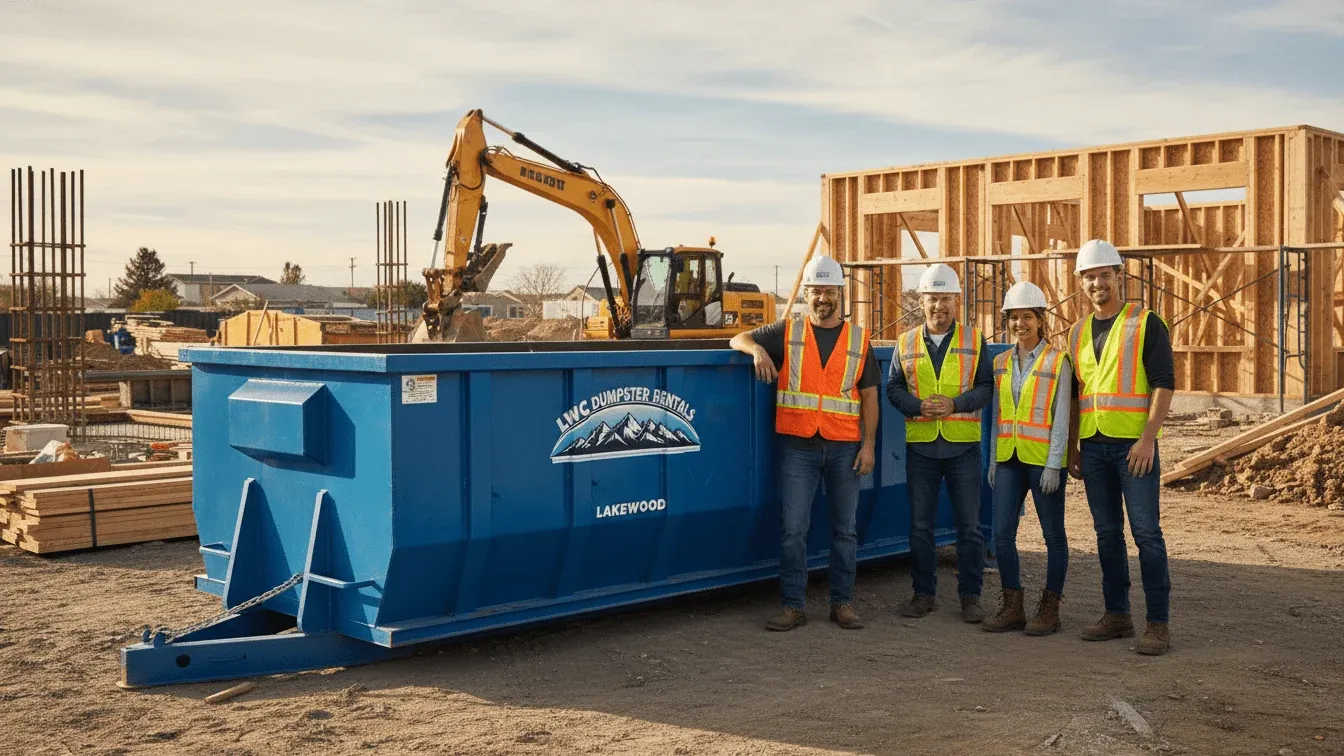
I have been setting cans on the ground in Lakewood, Wheat Ridge, Edgewater and west Denver since 2012, and what separates a contractor who breaks even on debris from one who bleeds on it is simple: construction and demolition debris is a regulated stream with its own facilities, its own rates and, in Colorado, its own permit gate. Run it like household trash and a scrape-and-build picks up a three-week delay. This is the walkthrough we give every GC who opens a construction dumpster account with us.
C&D debris and municipal solid waste do not go to the same place
Municipal solid waste is what comes out of a house or an office. It goes to a permitted MSW landfill or transfer station, priced by volume, because density is predictable. C&D debris is wood, drywall, roofing, concrete, brick, block, metal and dirt. Much of it goes to a C&D facility or specialty recycler, priced by weight, because density swings tenfold between framing scrap and broken slab.
Three things follow. A mixed can with lunch trash thrown in with demo debris can get reclassified at the gate, and reclassified loads cost more than either stream alone. Dense inert material has to be isolated. And clean single-material loads are the cheapest disposal in this metro.
The Colorado compliance layer: testing comes before the container
Colorado regulates asbestos under Air Quality Control Commission Regulation No. 8, Part B, administered by CDPHE's Air Pollution Control Division. Before you renovate or demolish and disturb more than the trigger quantities, the material must be inspected by a Colorado-certified asbestos building inspector. Not a home inspector. Not your best carpenter with a good eye. A state-certified inspector, with lab-analyzed samples.
The trigger quantities worth memorizing
- Single-family residential: 50 linear feet on pipes, 32 square feet on other surfaces, or the volume of a 55-gallon drum.
- Public and commercial buildings: 260 linear feet on pipes, 160 square feet on other surfaces, or a 55-gallon drum.
- Demolition: the structure or area coming down must be inspected regardless of quantity, and a notification goes to the state even when the inspection comes back clean.
Thirty-two square feet is nothing. That is a 5-by-6 patch of popcorn ceiling, and crews blow past it on the first morning of a bathroom gut. In much of this metro the demolition permit will not issue without the inspection report attached, so the sequence is not negotiable: test, then permit, then container. Order the can first and it sits on the driveway while a lab runs samples.
What actually comes back positive
On pre-1980 buildings, which is most of Lakewood, Wheat Ridge, Edgewater and west Denver, the repeat offenders are popcorn and textured ceilings, 9x9 and 12x12 vinyl floor tile plus the black cutback mastic under it, drywall joint compound, pipe and boiler wrap, and window glazing. Joint compound is the one that surprises people, because it turns an ordinary drywall pull into regulated work.
If the report comes back positive above the trigger, a licensed abatement contractor removes that material under its own manifest. It does not go in our can, or anyone else's. Once clearance is done, the rest is normal demolition debris and we can run it hard. We wrote a longer piece on asbestos testing before renovation in Colorado; it is worth ten minutes before you bid a 1958 ranch.
Denver's Waste No More ordinance changes how you sort inside city limits
If your project sits in the City and County of Denver, you are under Waste No More. Construction and demolition projects must plan for and carry out diversion of recoverable materials, and Community Planning and Development wants a recycling and reuse plan tied to the permit. Concrete, asphalt, clean wood, scrap metal and cardboard are the targets. Denver's universal recycling program page carries the current submittal requirements.
On the ground, a Denver jobsite runs more containers than a Jeffco jobsite of the same size, as separate streams rather than one mixed can. A Lakewood or Arvada job under Jefferson County jurisdiction has no equivalent mandate, so you separate because it saves money, not because a plan reviewer asks.
The mistake I see is a crew working both sides of Sheridan running the Denver job the way they run the Jeffco job. Get the plan right at preconstruction and it costs nothing; retrofit it at framing inspection and you pay two mobilizations. Unsure which rules apply to your address? Check our service area map.
What your debris actually weighs
Volume fills a box. Weight is what you pay for and what decides whether we can legally haul it.
| Material | Unit | Approx. weight | What it means for the container |
|---|---|---|---|
| Asphalt shingles, 3-tab | 1 square (100 sq ft) | 230–250 lbs | 20 sq single-layer tear-off, ~2.5 tons |
| Asphalt shingles, architectural | 1 square | 280–330 lbs | Add 30–40% for a second layer |
| Concrete, broken slab | 1 cubic yard | 3,700–4,000 lbs | 5 yards is a full legal 10 yard load |
| Brick and block | 1 cubic yard | 2,800–3,200 lbs | Dedicated heavy can, never mixed |
| Flagstone and landscape rock | 1 cubic yard | 2,600–3,000 lbs | A small patio maxes a 10 yard |
| Sod with soil attached | 1 cubic yard | 2,200–2,600 lbs | Wet sod runs heavier still |
| Soil and fill dirt | 1 cubic yard | 2,000–2,700 lbs | Dry vs. saturated: 700 lb swing |
| Drywall, 1/2 in. | 4x8 sheet | 51–55 lbs | A gut fills volume and weight together |
| Framing lumber, dimensional | 1 cubic yard | 300–400 lbs | Light for its bulk; 30–40 yard material |
| Cabinetry, trim and packaging | 1 cubic yard | 150–250 lbs | Pure volume, almost no weight |
Read the bottom three rows against the top five and the container strategy falls out of the table. Framing scrap is 350 pounds a yard; broken slab is nearly 4,000. Put them in one box and you either overweight a 30 yard at a third full or pay heavy rates on cabinet doors.
That is the whole argument for a dedicated 10 yard can on any job with inert material. Low walls a laborer can pitch into without a ramp, and it hits the legal road limit before it looks full. Our concrete and heavy debris service exists for this one job.
When the 40 yard earns its keep, and when it is a liability
The 40 yard is the best value per yard we rent and the fastest way to waste money, depending entirely on what goes in it.
It earns its keep on bulky-light phases: framing scrap on a production build, siding and housewrap tear-off, cabinetry and millwork demo, commercial fit-out ceiling grid and partition, packaging on a large finish package. Anything where volume runs out long before weight does. On a multi-unit framing package a 40 saves two or three trips a week, and every trip you do not pay for is margin.
It is a liability when the debris is dense, the site is tight, or the driveway is on a grade. A 40 is roughly 22 feet of box plus truck, needs 60-plus feet of straight approach and about 23 feet of overhead clearance. On a 1949 Lakewood lot with a single-width drive and a mature silver maple over it, a 40 is a phone call telling you we could not make the set. In dense material it is worse than useless: the box will accept far more weight than the truck can legally carry. When a 40 does not fit, a 30 with next-day swaps beats it.
Sequence containers, do not oversize them
The oversizing instinct comes from fear of running out. Swap-outs solve it cheaper. Here is how we sequence a scrape-and-build:
- Demo: a 20 or 30 for mixed structural debris plus a dedicated 10 for concrete and brick. Post-abatement only.
- Excavation and flatwork: 10 yard heavy cans on call. Dirt and slab never share a box with wood.
- Framing and exterior: a 30 or 40, plus separate piles for clean wood and scrap metal.
- MEP rough: a 15 or 20 is plenty; the copper and steel are worth money at the scrapper.
- Drywall and finish: a 20, swapped once or twice, cardboard pulled separately.
- Punch and turnover: a 10 or 15 for packaging and cleanup.
Six containers, none oversized, each right for its phase.
Metro logistics: alleys, infill, foothills and fresh flatwork
Alley access on older lots. Much of Lakewood, Edgewater and northwest Denver was platted with alley service. Those alleys are narrow, often unpaved, and frequently blocked by a neighbor's trailer or a low utility drop.
Tight infill scrapes in Denver. Twenty-five and thirty-foot lots with the new build running to the setbacks. Once the foundation is in there is often no on-site placement left, which means a street set and a right-of-way permit. Pull it early.
Foothills driveways. Toward Morrison, Indian Hills and Evergreen the drives are steep, curved and sometimes gravel. A loaded roll-off does not back down a 15 percent gravel grade in the wet. We stage at the flat pad near the road and let your crew wheelbarrow the last stretch.
Fresh flatwork. New concrete does not take a loaded roll-off for at least 28 days, and even cured residential flatwork cracks under the point load of the rear wheels. We run plywood or steel plate under every set on finished surfaces — see our guide to driveway protection during delivery.
Separate the streams that pay you back
Three streams are worth pulling out on almost any job. Scrap metal is the obvious one: copper, brass, aluminum, cast iron radiators, ductwork, structural steel. It carries positive value and it is free weight out of a can you pay for by the ton. Clean wood means dimensional lumber, pallets and untreated cutoffs. Cardboard is the biggest volume hog on a finish package and nearly free to recycle. On a Denver job those three are part of your Waste No More plan anyway; on a Jeffco job they are money. Options are in recycling and disposal in Jefferson County.
Colorado landfill restrictions that show up on jobsites
Colorado bans several materials from landfill disposal and they turn up in demo constantly. CDPHE's prohibited-disposal list covers electronics, waste tires, lead-acid batteries, used oil and free liquids. Add the ones every hauler refuses: paint and solvents, fuel, propane and pressurized cylinders, refrigerant-bearing appliances not evacuated and tagged, and anything asbestos-containing. Basement and garage cleanouts on older properties produce all of it. Stage it to the side rather than burying it mid-can, which is how a load gets rejected at the gate.
Build the calendar around hail season
From May through September the Front Range gets hail, and when a supercell tracks across Lakewood, Arvada or Wheat Ridge, every roofer in the metro calls for a can inside 48 hours. That is not a market you schedule into on Tuesday for Wednesday. Roofers holding a standing account get containers that week; everybody else waits. If you run tear-offs, read our tear-off sizing guide and the hail damage replacement guide, and see our roofing dumpster service.
The rest of the calendar matters too. Afternoon thunderstorms in July and August mean an open can takes on water, and water is weight you pay for, so tarp before you leave. High wind on the hogback side of the metro lifts loose sheet goods straight out of a box, so load heavy on top. December through March, frozen ground and mud season limit where we can set, and a container frozen into the ground is one nobody pulls until it thaws.
Put an account behind it
Every contractor who works with us at volume ends up on the same arrangement: a standing account, flat-rate pricing so the bid you wrote is the bid you pay, next-day swap-outs, and one number instead of a dispatch queue. Cole Barrett has run this company out of west Denver since 2012, and we set cans in Lakewood, Golden, Wheat Ridge, Arvada and Morrison every day. Call LWC Dumpster Rental Lakewood at (720) 473-6600 and we will map your container sequence before you break ground.
Questions this guide did not answer? Call (720) 473-6600. We would rather spend two minutes on the phone than have you order the wrong container.