Landscaping
Ripping Out the Lawn: A Practical Guide to Xeriscape and Landscaping Debris in Lakewood
Sod is soil and landscape rock is a quarry product. A Lakewood operator breaks down turf replacement debris by weight, why the small container wins, how to sequence the job, and what to divert.
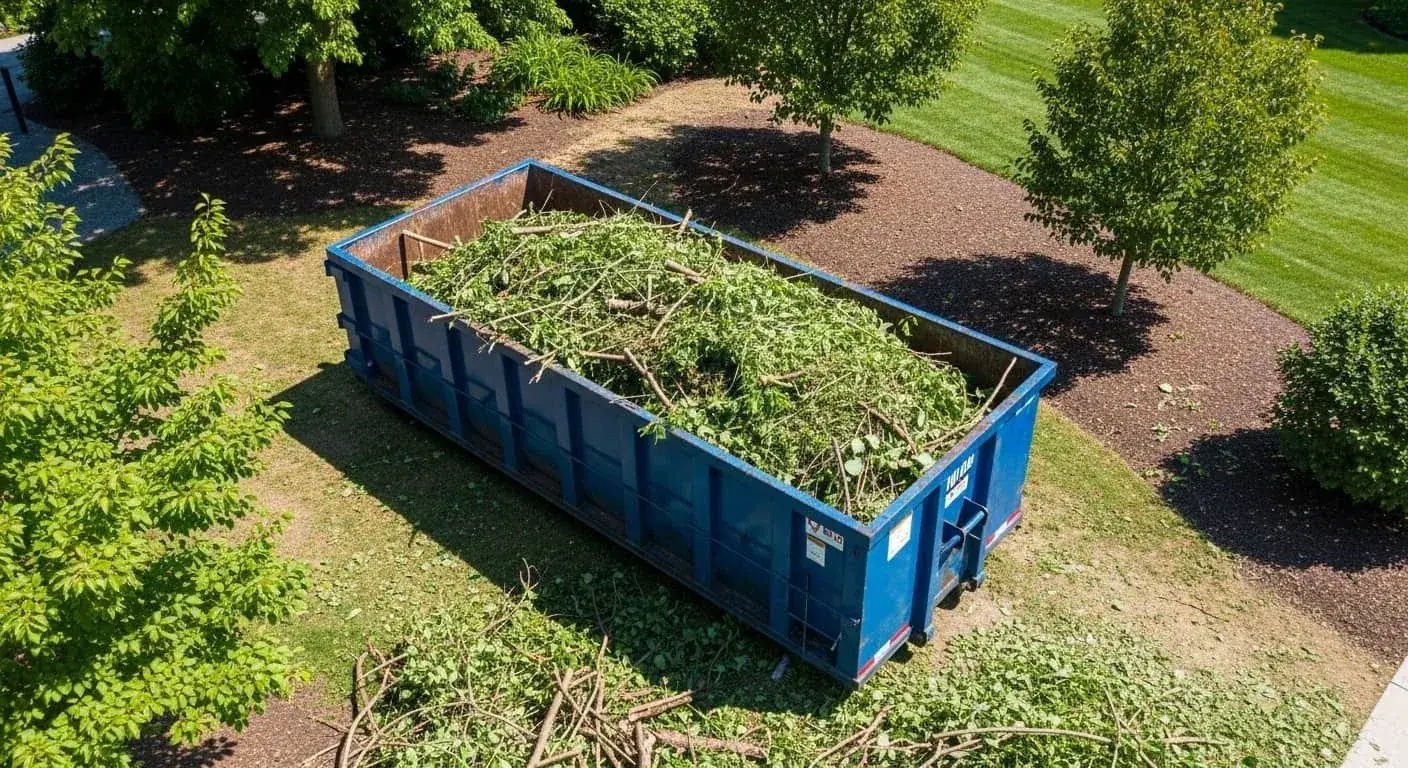
I have been hauling landscape debris out of Lakewood driveways since 2012, and one job catches more homeowners out than any other: pulling the bluegrass and putting in a water-wise yard. The material is simply heavier than it has any right to be, and nobody believes me until the truck squats on its springs leaving the driveway.
Landscaping debris is the most deceptive material in this trade. It looks like yard waste. It weighs like a quarry. A homeowner calls and says "it's just the front lawn, maybe 800 square feet." What comes out of that yard is three to five tons of wet dirt with green on top. Get the container wrong and you either pay overage you did not budget for, or you end up with a half-empty can you legally cannot move.
Why half of Lakewood is ripping out the lawn
Two things are driving this. The first is geography. We sit at 5,500 feet on the dry side of the Front Range with roughly 15 inches of annual precipitation, and Kentucky bluegrass wants about double that. Every irrigated lawn in Jefferson County is a plant living outside its range, kept alive by a sprinkler clock.
The second is money moving the other way. Colorado has put real public funding behind turf conversion through a state turf replacement grant program administered by the Colorado Water Conservation Board, which passes dollars down to local water providers and municipalities. Those providers then run their own rebates for homeowners, HOAs and commercial properties converting irrigated cool-season grass to water-wise landscaping.
Here is the part specific to us: Lakewood is not served by one water utility. Depending on which side of Wadsworth or Kipling you sit on, your provider might be Denver Water, Consolidated Mutual, Green Mountain Water and Sanitation, Bancroft-Clover or a smaller district. Rebate amounts, caps and application windows are set by your provider, not the city and not us. Find the name on your water bill and start there. Do not tear out a square foot before you have pre-approval, because nearly all of these programs require before photos and will not pay retroactively.
The weight problem, which is really the whole article
Every decision on this job flows from one fact: you are not disposing of plants. You are disposing of dirt and stone.
Sod is soil with a haircut
A sod cutter does not shave off the blades. It slices under the root zone and lifts a strip carrying two to four inches of moist soil plus whatever clay is bound into the thatch. Our soils are heavy — tight clay through most of the Bear Creek and Green Mountain neighborhoods — and clay holds water like a sponge.
Run the arithmetic on a modest job. A 1,000 square foot front yard stripped at three inches is about 250 cubic feet, call it 9 cubic yards. At roughly 2,000 pounds per cubic yard for damp stripped sod, that is nine tons out of a "small" front lawn. More weight than a full roofing tear-off on the same house. And wet sod runs 20 to 30 percent heavier than sod cut after three dry days, so let the yard dry down before the cutter comes through.
Rock is a quarry product and it prices like one
Old decorative rock is the other half of the job, because most Lakewood yards being converted already have rock somewhere — a strip along the foundation, or a mulch bed that got graveled over in 2009. River rock, cobble and 3/4-inch gravel all run 2,400 to 2,800 pounds per cubic yard. Stacked flagstone is heavier. Boulders and split-face wall block heavier still.
Which means a container holding rock hits its legal road weight while it still looks half empty. That is axle law, and an overweight truck does not leave your street.
| Material | Approx. lbs per cubic yard | What that means | Container |
|---|---|---|---|
| Stripped sod (moist, 2-3 in. soil) | 1,800 - 2,300 | About a ton per 100-120 sq ft | 10 yard |
| Topsoil / excavated clay | 2,000 - 2,700 | Heavier wet; clay is the worst | 10 yard |
| River rock and cobble | 2,400 - 2,800 | 3 cubic yards is roughly 4 tons | 10 yard |
| 3/4 in. gravel / road base | 2,500 - 2,800 | Packs dense, almost no voids | 10 yard |
| Flagstone (stacked) | 2,800 - 3,400 | Divert clean stone if you can | 10 yard |
| Boulders / wall block | 3,000 - 4,000 | Load low and flat, never high | 10 yard |
| Green waste, brush, slash | 250 - 500 | Bulky and light; volume is the limit | 20 or 30 yard |
Why the 10 yard is right and the 30 yard is wrong
This is the most counterintuitive thing I tell customers, and it saves them the most money. For sod, soil and rock, the 10 yard dumpster is the correct container. Not because it holds enough, though by weight it holds plenty. Because it has a low wall, sits low for wheelbarrow and shovel work, and fits a standard Lakewood driveway without crowding the garage door or the sidewalk.
A 30 yard is exactly the wrong tool here. You hit the road weight limit with the can barely a third full, you paid for volume you cannot legally use, and you spent two days throwing 40-pound rocks over a six-foot wall. Our guide on what size dumpster you need in Lakewood runs the same logic on other materials, and our concrete and heavy debris service is built around dense loads like these.
How to actually sequence the job
Order matters, and where the container sits in that order decides whether you rent once or three times.
- Kill or cut the turf. Smother it over several weeks, spray it and wait out the label interval, or go straight to a rented sod cutter. Mechanical is faster and it is the only method that takes the thatch and root mat with it.
- Strip and stack. Cut the yard into strips, roll them, stage them near the drive. A rolled strip is far easier to carry and drops into the can cleanly.
- Deal with the grade. You just removed three inches of yard. Decide now whether you backfill with amended soil or set the new rock down into that recess. Good conversions often use it deliberately as shallow catchment.
- Pull the old rock and weed barrier. Rake or screen out existing gravel, then pull the plastic or fabric underneath. Twenty-year-old fabric comes up in shredded ribbons full of embedded gravel. Budget more time than you think.
- Pull the irrigation you are abandoning. Cap dead zones at the manifold, salvage the brass and the good rotors, pull the poly drip and funny pipe. Do it before you cover anything.
- Bring in the new material. Amendment, plants, mulch, cobble, edging — only after the debris is gone and the can is off the drive.
The split-container strategy
Here is what an experienced crew does and a first-timer never thinks of: run two containers, sized differently, for two problems.
The 10 yard takes the heavy fraction — sod, soil, rock, flagstone, wall block, broken concrete edging. It sits closest to the work, gets loaded low and flat, and leaves heavy.
A separate 20 yard takes the light and bulky fraction — old fence panels and posts, rotted timbers, weed fabric, cracked pots, sprinkler pipe, root balls and green waste. That is all volume and no weight, which is what a bigger can is built to swallow. Our yard waste removal covers the green side and residential dumpster rental the mixed household side. Usually cheaper than fighting one oversized container that gets weight-capped.
What is worth diverting rather than dumping
- Clean concrete and flagstone. Walkways, patio slabs and broken sandstone go to a crusher and come back as road base. Keep it clean, no dirt clods or rebar tangles, and it stops being waste.
- Clean landscape rock. Rock does not wear out. Screen it, wash it, reuse it in a dry creek bed or a side path. If you truly do not want it, list it free locally and it is gone in a weekend.
- Green waste and slash. Branches, brush and shrub removals go to mulch and compost streams rather than the landfill. Keep the green pile clear of plastic, wire and rock or the load gets rejected.
- Scrap metal. Steel edging, chain link, fence posts, brass valves and copper fittings all have scrap value. Set them aside instead of burying them under sod.
Our breakdown of recycling and disposal in Jefferson County covers where each stream actually goes.
The foothills angle: defensible space and slash
West of C-470 the same project takes on a second purpose. Around Morrison, Evergreen, Conifer and Ken Caryl, thinning vegetation is wildfire mitigation as much as water conservation, and defensible-space work produces enormous slash piles.
Slash is the one landscape material where a dumpster is often not the answer. Jefferson County and several mountain fire protection districts run seasonal slash collection and chipping sites, usually free or nearly so for residents. Check your fire district and the county first. We come in for the rest: railroad ties, the failed retaining wall, the rock and the fencing a slash program will not take.
Placement, buried utilities, and protecting what you are about to build
A turf conversion carries a unique risk: you are setting a very heavy object on a driveway you may be replacing, next to irrigation you intend to keep.
A loaded rock container is one of the heaviest things that will ever sit on residential concrete. If the drive is old, cracked or scheduled for replacement, say so. We put plywood or cribbing under the rails as a matter of course — see our guide to driveway protection during dumpster delivery.
Before the truck backs in, flag every sprinkler head, valve box, manifold, drip line and the sewer cleanout. They sit flush with grade and are invisible from a truck cab, and a cleanout crushed by a rear axle costs more to repair than the whole rental.
Before any real digging — footings for a boulder wall, a dry well, trenching for new mainline — call Colorado 811. It is free, it is legally required, and you need at least three full business days before you break ground. Gas service lines in older Lakewood neighborhoods do not run where you would expect.
If the can has to sit on the street rather than the drive, check right-of-way permitting with the City of Lakewood first; we walk through it in our post on dumpster permits in Lakewood.
Timing: pick your window
Spring and early autumn are the windows on the Front Range, and it is not close. April through early June and September through late October give you workable soil, a real chance of establishing new plantings, and air you can breathe on a shovel.
Midsummer at 5,500 feet is brutal. The sun at altitude is punishing, the clay bakes close to concrete, a sod cutter fights every pass, and new plantings need babysitting to survive July. Winter is worse — frozen ground will not release sod. Running it in phases? Demo in fall, plant in spring.
Call with the square footage, not a guess at the yardage
The most useful thing you can tell me on the phone is not "I need a dumpster." It is "I am pulling 900 square feet of sod at three inches, plus 200 square feet of river rock four inches deep." Give me those numbers and I will size it by weight and tell you honestly whether you need one can or two — pricing is broken down in our Lakewood dumpster rental cost guide.
We are flat-rate, licensed and insured, and we deliver same-day or next-day across Lakewood, Golden, Wheat Ridge, Morrison, Littleton and the west Denver metro. Measure the yard, pull your water provider's rebate rules, then call LWC Dumpster Rental Lakewood at (720) 473-6600 or reach us through our contact page, and we will have the right can on your driveway before the sod cutter shows up.
Questions this guide did not answer? Call (720) 473-6600. We would rather spend two minutes on the phone than have you order the wrong container.