
Roofing
Roof Tear-Off Dumpster Sizing in the Denver Metro: Get It Right the First Time
A Lakewood operator's guide to sizing a roof tear-off dumpster: roofing squares, pitch multipliers, shingle tonnage by material, why 30 and 40 yard cans fail, placement and Colorado weather windows.
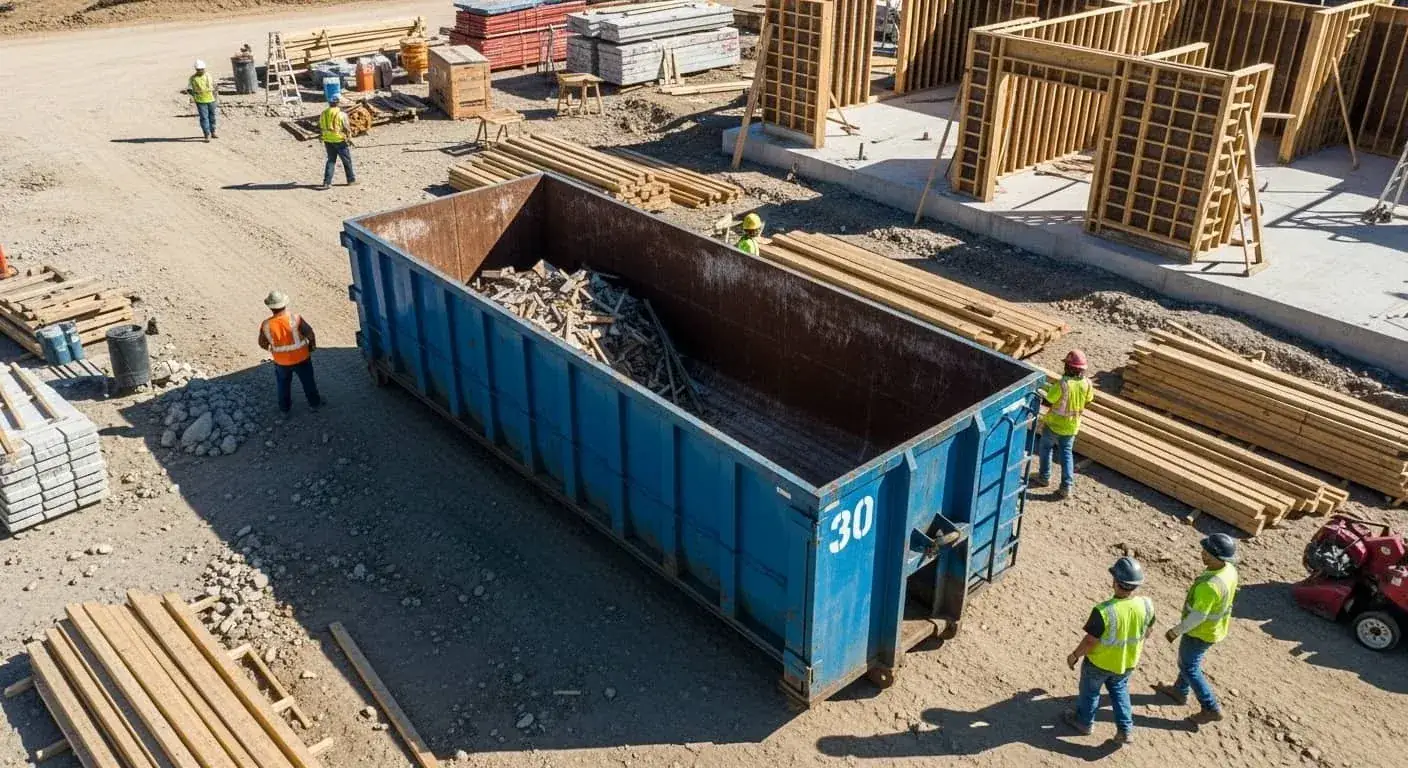
I have been putting cans on driveways in Lakewood since 2012, and roofing is the one trade where sizing goes wrong in the most expensive direction. Every other job you underestimate volume. On a tear-off you underestimate weight. A roof looks like a small pile of debris until it is in the box, and then the truck cannot legally leave your street with it.
This is the sizing guide I give crews and homeowners who call our office. The insurance side of a hail claim is its own animal, covered in the hail damage roof replacement guide. Here we are talking squares, tons, placement and haul counts.
The Roofing Square Is the Only Unit That Matters
A roofing square is 100 square feet of finished roof surface. Every estimate, bundle count and dump ticket traces back to it. Getting squares from a house takes two steps: measure the footprint including overhangs, then multiply by the pitch factor, because a roof is a hypotenuse, not a floor.
- 4/12 pitch (common on 1960s Lakewood ranches): multiply footprint by 1.054
- 6/12 pitch (the metro default): multiply by 1.118
- 8/12 pitch: multiply by 1.202
- 10/12 pitch (many Genesee and Evergreen builds): multiply by 1.302
- 12/12 pitch: multiply by 1.414
So a 2,000 sq ft single-story footprint at 6/12 is roughly 2,240 sq ft of roof, or about 22.4 squares. Add 5 to 10 percent for waste, hips, valleys and starter, and call it 24. That number drives everything that follows.
The Weight Math Nobody Runs Until It Is Too Late
Here is where the container decision actually gets made. Shingle weight per square, straight from the bundle wrappers we see come off roofs every week:
- Standard three-tab: roughly 220 to 250 lbs per square
- Architectural / dimensional: roughly 350 to 450 lbs per square
- Class 4 impact-resistant: roughly 430 to 500+ lbs per square
- Cedar shake: roughly 350 to 500 lbs per square, and heavier when it has been rained on
- Concrete or clay tile: roughly 900 to 1,200+ lbs per square
Run that 24-square architectural roof: 24 × 400 lbs = 9,600 lbs. That is 4.8 tons of shingle alone. Add what always comes with it — synthetic underlayment or 15 lb felt, drip edge, step and counter flashing, ridge vent, pipe boots, and the two or three sheets of rotten decking over the north-facing valley — and you are at 5.5 tons before anyone sweeps the driveway. Five tons of shingle occupies about 12 to 14 cubic yards. The weight fills the truck long before the debris fills the box.
Multi-Layer Roofs Change Everything
Before 2000 it was routine around here to shingle over an existing layer instead of tearing off. We still find two layers on a huge share of pre-1985 homes in Lakewood, Wheat Ridge, Edgewater and old Applewood, and occasionally three. Every added layer roughly doubles or triples your tonnage. Two layers of architectural on a 24-square roof is 9 to 10 tons. Three layers on an 18-square ranch — often three-tab over three-tab over cedar — runs 7 to 9 tons and adds splintered wood shake that will not compact. Have a roofer lift a shingle at the eave and count layers before you order anything.
Denver Metro Roofing Realities
Class 4 Impact-Resistant Shingles Are Everywhere Now
The Front Range takes more damaging hail than almost anywhere in the country, and after the 2017, 2018 and 2023 storm cycles a very large share of metro roofs went back on with Class 4 impact-resistant product to earn the insurance discount. Those shingles are thicker, denser, often with an SBS-modified asphalt layer, and run meaningfully heavier per square than the architectural they replaced.
The practical effect: roofs that are now hitting their second replacement cycle are coming off heavier than they went on the first time. If a homeowner tells me the roof was done after a hail claim in the last ten years, I assume Class 4 and I budget 450 to 500 lbs per square. On a 30-square house that is a 7-ton load out of what looks like an ordinary suburban roof.
Tile Roofs Are a Completely Different Job
Concrete and clay tile shows up on the newer south-metro and Solterra builds, on Ken Caryl, on parts of Roxborough and Highlands Ranch, and on the Spanish-revival stock scattered through Denver. At 900 to 1,200+ lbs per square, a 25-square tile roof is 11 to 15 tons. There is no single roll-off on earth that legally hauls that.
Tile gets the same treatment as any dense debris: a small can, loaded low, hauled repeatedly. We put a 10 yard dumpster on tile jobs and plan on three to five swaps. Same logic we use for concrete and heavy debris. Do not let anyone talk you into a big box for tile — you will fill it a quarter of the way up and it still will not leave the property.
Cedar Shake in the Foothills
Older homes above C-470 and up through Lookout Mountain, Genesee and Evergreen still carry cedar shake, and it is coming off steadily because of wildfire code. Jurisdictions across the WUI have tightened roof-covering requirements, and insurers have gotten aggressive about non-renewal on wood roofs. Shake tears off fast but rides bulky — cupped, splintered, full of air — so you run out of volume before you run out of weight. That is the one roofing material where a 20 yard genuinely earns its keep on a mid-size house.
Low-Slope and Flat Roofing
Mid-century flat-roofed homes across Lakewood and Denver, plus most small commercial along Colfax and Wadsworth, run modified bitumen or built-up over ISO insulation board. The membrane is heavy and wet, the insulation is light and bulky, and old gravel-surfaced layers underneath push the weight up fast. Call and describe the assembly before we deliver.
Sizing Table: Squares to Tons to Container
| Material | Lbs / Square | 20 Squares | 30 Squares | Recommended Container |
|---|---|---|---|---|
| Three-tab, 1 layer | 220–250 | 2.2–2.5 tons | 3.3–3.8 tons | 15 yard (up to ~30 sq) |
| Architectural, 1 layer | 350–450 | 3.5–4.5 tons | 5.3–6.8 tons | 15 yard to 25 sq; 20 yard beyond, or two hauls |
| Class 4 impact-resistant | 430–500 | 4.3–5.0 tons | 6.5–7.5 tons | 15 yard, plan a swap over 25 sq |
| Cedar shake | 350–500 | 3.5–5.0 tons (high volume) | 5.3–7.5 tons | 20 yard — volume-driven, not weight-driven |
| Concrete / clay tile | 900–1,200+ | 9–12 tons | 13.5–18 tons | 10 yard, 3–5 hauls |
| Any material, 2 layers | double above | — | — | 15 yard + scheduled swap-out |
Why a 30 or 40 Yard Is Almost Always Wrong for a Tear-Off
This is the single most common mistake, and it usually comes from a homeowner thinking bigger is safer. It is not. Roll-off trucks operate under Colorado legal axle and gross weight limits. Load a 30 or 40 yard with shingle and you hit that ceiling somewhere around the halfway mark — you have rented forty yards of steel and legally cannot use more than eighteen of it.
Worse, big cans are long. A 40 yard needs roughly 40 to 45 feet of straight approach plus overhead clearance, which most driveways off Garrison, Kipling or Carr do not have. Those boxes belong on framing debris and siding, not shingle.
The residential tear-off workhorse is the 15 yard. Low walls, short footprint, easy tarp-and-slide target, and you can put a legal load of shingle in it. Step up to the 20 yard for shake, big multi-layer jobs, or when decking replacement is part of the scope. The general decision framework is in what size dumpster do I need.
Placement: Put the Can Where the Crew Is Working
A tear-off container is a target, not a storage unit. Where it sits decides whether the crew tarps and slides straight off the eave or hand-carries bundles across a lawn all afternoon.
- Set it on the tear-off side. Roofers work one plane at a time. The can goes under the largest continuous slope, close to the eave, so shingle slides down a tarp or chute straight in.
- Six to ten feet of standoff. Close enough to catch debris, far enough for the truck to winch it on.
- Protect the flatwork. Our protection boards go under the rails on every delivery, standard. That matters on stamped concrete, new pavers and soft July asphalt — more on driveway protection.
- Alleys. Older Lakewood and west Denver lots off Sheridan have rear alley access, often the right call — but measure width and watch overhead utility drops. We need about 22 feet of vertical clearance to raise the box.
- Foothills driveways. Steep and curved is workable; steep, curved and gravel after a wet week is not. Tell us the grade when you book.
- Right-of-way. If it has to sit on the street, you may need a permit. See Lakewood dumpster permits and the City of Lakewood site.
The Colorado Weather Window
Altitude changes the job. High-elevation UV is brutal, and in July and August a south-facing deck hits 160°F by 1 p.m. Asphalt goes soft, shingle tears instead of lifting clean, and debris glues into mats in the bottom of the can. Good crews start at 6 a.m. and are off the steep planes by early afternoon.
Then the afternoon storms. From late June through August the Front Range builds cells nearly every day between 2 and 5 p.m., and nobody leaves a deck open into that. Spring and fall wind events will lift loose shingle off an open deck and scatter it three yards down the block — one more reason to keep the can tight to the work instead of parked at the curb.
Winter is a scheduling problem more than a technical one. Shingle gets brittle below about 40°F, sealant strips will not bond, and one snow event idles a crew for three days with your can sitting on the driveway. Doable in a warm January stretch — just build slack into the rental window.
What Rides Along and What Cannot
Everything the tear-off produces goes in the same box: shingle, felt and synthetic underlayment, nails, drip edge, flashing, ridge vent, pipe boots, gutters, fascia, soffit and replaced decking.
What stays out: unopened or partial sealant, roof cement and solvent cans, propane cylinders and torch bottles from a mod-bit job, batteries, and anything on Colorado's prohibited list. Full breakdown is in what can go in a dumpster in Jefferson County, plus CDPHE for state waste rules. On pre-1980 homes, if the assembly includes old built-up or transite-type material, get it tested first.
Swap-Outs and Nail Cleanup
On any job over 25 squares with two layers, plan the swap before day one. Call it in when the can is roughly three-quarters full and we will usually have an empty on site the same day or first thing next morning. You do not want a crew stalled at 10 a.m. with a full box and half a roof stripped.
Load flat and load low. Shingle laid in even courses uses the cube properly; heaped in the middle it bridges, leaves air, and hits weight early. Keep debris below the rail line — anything above it comes off before the truck moves.
Last thing every day: roll a magnet. Twice over the driveway, once around the perimeter, once along the street. Every tear-off drops thousands of nails, and a punctured-tire callback costs more than the rental. Sweep gutters and window wells too.
Book It Right
We are flat-rate, licensed and insured, and we run same-day and next-morning delivery across Lakewood, Jefferson County and the west metro. After a hail event, roofing contractors on a standing account get priority routing — one call, next-morning drop, no re-quoting every address. Tell us squares, layers, material and pitch and we will tell you the container and the haul count.
Set up a contractor account or book a single tear-off can. Call LWC Dumpster Rental Lakewood at (720) 473-6600 and we will get it right the first time.
Questions this guide did not answer? Call (720) 473-6600. We would rather spend two minutes on the phone than have you order the wrong container.