Permits & Rules
Do You Need a Permit for a Dumpster in Lakewood, CO?
A Lakewood operator explains when a dumpster needs a city right-of-way permit, when your driveway is fine, how HOA covenants and CDPHE asbestos rules fit in, and what skipping paperwork costs.
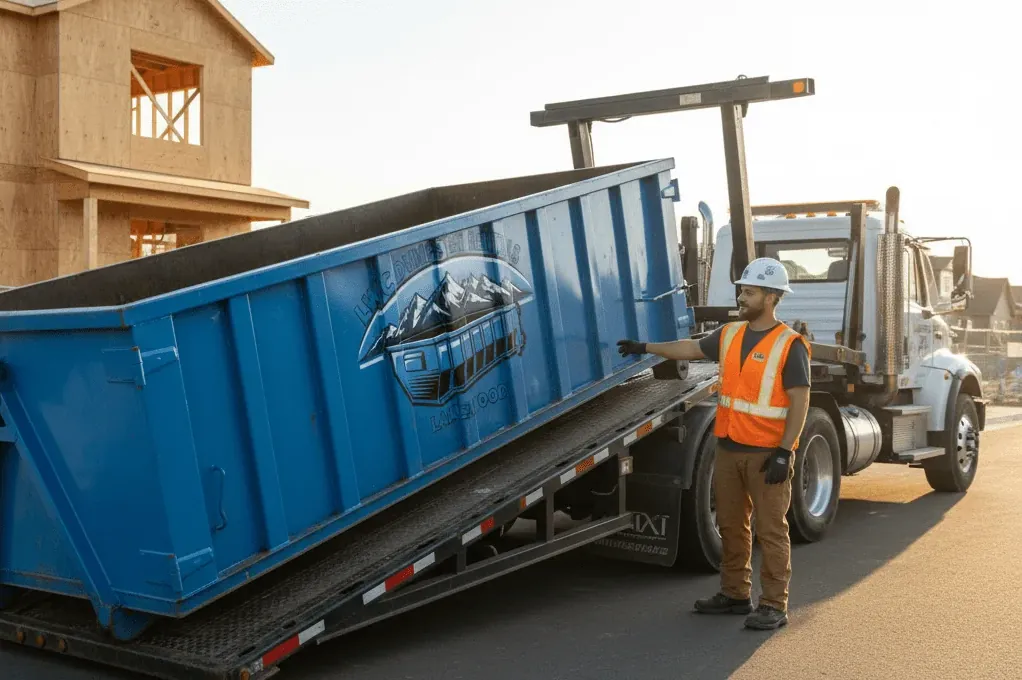
I have been setting roll-off containers on the west side of the Denver metro since 2012, and the permit question comes up on about one call in five. Most of the time you do not need one — and the jobs where you do are exactly the ones where finding out late costs you a week and a red tag.
The short answer: it depends which side of the property line it sits on
One rule explains most of this. If the container sits on your own private property — driveway, parking pad, gravel side yard, a commercial lot you own or lease — you generally do not need a municipal permit.
If it sits in the public right-of-way — street, curb lane, sidewalk, the tree lawn between sidewalk and curb, or a public alley — you are occupying land the public owns, and Lakewood typically wants a right-of-way or revocable permit first. If the frontage is a state highway, CDOT may be the approving authority instead.
Private driveway: the default, and why we push for it
Most of the residential dumpster rentals we run in Lakewood go on the driveway, on purpose. No application, no lead time, no traffic control, and the box sits inside your own space.
The trade-off is your concrete. A loaded 20-yard is heavy, and 1950s and 60s ranch driveways are not always in a condition to enjoy that — we put boards under the rails as a matter of course, covered in our guide to driveway protection at delivery. On a short pad, dropping one size beats moving to the street and triggering a permit; our Lakewood size guide works through it.
Public right-of-way: when the City of Lakewood gets involved
Street placement is common near Belmar, along Colfax and through Eiber and Two Creeks — anywhere the driveway is too steep, too short or already full of a contractor's equipment. Plan on a right-of-way permit.
Who applies, and how far ahead
The permit is usually pulled by a licensed contractor — often the GC or roofer, sometimes the hauler, occasionally the homeowner. Some offices will not issue one to a homeowner at all, because the applicant has to carry contractor insurance naming the city. Ask before you assume.
This is not a same-day item. A simple residential occupancy is often turned around quickly; anything that closes a travel lane, touches an arterial or needs a real traffic-control plan takes longer. Build in several business days at minimum, start the conversation the week you schedule demo, and confirm the current turnaround with the city — staffing and volume move it.
What the application usually asks for
- A site sketch showing the container relative to the curb, sidewalk, driveway cuts, hydrants and intersections
- The duration — start and end dates, not "until we're done"
- Container size and how much of the travel or parking lane it takes
- Traffic control — cones, delineators, reflective marking, sometimes signage or a plan to MUTCD standard
- Proof of insurance from a licensed contractor, often naming the city as additional insured
- The related building or demolition permit number, where the container serves permitted work
Forms, fees and portals change, so pull current requirements from the City of Lakewood rather than from a rental company's website — including this one.
State highways and CDOT
Some roads that feel like ordinary city streets are state highways. Occupying that right-of-way generally runs through CDOT instead of the city, and review is heavier because speeds are higher. Rare on residential work, common on commercial jobs with highway frontage. If you do not know who owns the road out front, ask the public works counter before you schedule anything.
| Where the container sits | Who approves it | Typical lead time | What is usually required |
|---|---|---|---|
| Private driveway or lot | Nobody — the owner's call | Same day possible | Owner permission, clear access, surface protection |
| City street, curb, sidewalk or alley | City right-of-way / public works | Several business days; longer for lane closures | Sketch, dates, container size, cones and reflectors, contractor insurance |
| State highway frontage | CDOT, sometimes with city sign-off | Longest — weeks, not days | Formal traffic control plan, insurance, engineered detail |
| HOA or metro-district community | HOA board, manager or architectural review | Days to a full meeting cycle | Written approval, day limits, driveway-only placement |
| Commercial or shared site | Property owner or manager; city if in the ROW | One to three days typical | Landlord sign-off, fire-lane clearance, parking counts |
The metro reality: every jurisdiction runs its own show
This is what catches contractors working across the metro. There is no single Denver-area dumpster permit. Lakewood, Denver, Golden, Wheat Ridge, Arvada, Edgewater, Littleton, Englewood, Sheridan and unincorporated Jefferson County each run a separate process with its own form, portal, lead time and conditions. An approval from one means nothing two blocks across a boundary.
Denver runs its own street occupancy permitting system, more formalized than most of its neighbors. Unincorporated Jeffco is a different track again, handled through Jefferson County rather than any city. Boundary confusion is the real hazard: west Denver, Edgewater and Lakewood interlock in ways that surprise people, and there are blocks near Sheridan Boulevard where the mailing address says one city and the pavement belongs to another. Our service areas page shows where we run; if you are not sure which office to call, ask us.
HOA and metro-district approval: the one that actually bites
The rule I would tattoo on new homeowners: the city is usually not the problem, the HOA is. In the newer covenant-controlled communities on the west side — Green Mountain, Solterra, Ken Caryl and the metro districts around them — association rules are routinely tighter than anything the city imposes:
- Day limits capping how long a container may sit, sometimes three to seven days, extensions by written request
- Driveway-only placement, forbidding street containers even where the city would permit one
- Architectural review notification before the renovation, which runs on a committee calendar, not yours
- Screening, delivery windows and weekend restrictions in tighter districts
Metro districts add a wrinkle: a district can own streets and open space that look public but are not. Read the covenants, then get your manager's answer in writing. Fines land on the homeowner, not the hauler, and "the dumpster company said it was fine" has never once worked as a defense.
Alleys on older Lakewood and west Denver lots
Plenty of pre-war and mid-century lots in west Denver, Edgewater and east Lakewood have alley access and no usable driveway. Alleys make good placements — out of the traffic lane, close to the back of the house for a cleanout or a garage teardown. Two catches. A public alley is still public right-of-way, so the same permit logic applies. And alleys are narrow: a truck needs room to back in, tilt the bed and pull forward off the container, and sagging power and cable lines are a real constraint. We want the width, the surface, and whether trash service runs through — blocking a refuse route gets you a phone call fast.
Foothills and mountain lots toward Morrison and Evergreen
West of C-470 the permit question mostly disappears and access replaces it. Steep driveways are the main limiter: a loaded container on a serious grade is a safety problem for the driver and for whatever is downhill, and on gravel there is a real chance of losing traction on the way out. Many foothills roads are privately owned by a road association, so the association — not the county — sets weight limits and access rules, some of them seasonal during spring mud.
Our most common mountain job is wildfire mitigation. Slash from thinning around a structure is enormous volume for very little weight, so a yard waste container or a 30-yard roll-off is usually right. Keep slash separate from construction debris — mixed loads get charged as mixed loads.
Building and demolition permits are a separate track — and asbestos comes first
People conflate these constantly. A right-of-way permit authorizes the container in the street. A building or demolition permit authorizes the work. Different applications, different departments, and you can have one without the other.
The Colorado wrinkle: for demolition and many renovations, the building permit is commonly tied to a CDPHE Regulation No. 8 asbestos inspection by a Colorado-certified inspector. That inspection happens before the permit, which is before demo, which is before you need the container. On anything built before the 1980s — popcorn ceilings, vinyl floor tile and mastic, duct wrap, roofing felts — assume you need to test. We go deeper in our piece on asbestos testing before a Colorado renovation, and the requirements live with the Colorado Department of Public Health and Environment.
Sequence it this way and nothing stalls: asbestos inspection, building or demo permit, right-of-way permit if needed, then the demolition debris container.
Placement rules that keep you legal in any jurisdiction
Permit or not, these hold everywhere, and breaking them is how a no-permit-needed driveway job turns into a complaint:
- Never block a sidewalk. Pedestrian access is an ADA issue and the fastest route to a complaint
- Stay clear of hydrants and never obstruct a commercial fire lane
- Protect mailbox and USPS access. A carrier who cannot reach the box suspends delivery for the whole block
- Keep storm drains and gutter flow clear — a container over an inlet is a problem the moment a storm rolls off the foothills
- Do not occupy a bike lane without explicit authorization
- Do not block a neighbor's driveway or access, even partially
Overhead clearance for the hoist
Invisible until it is a disaster. A roll-off truck raises its bed well above cab height to set and retrieve a container — we plan on roughly 22 to 25 feet of vertical clearance and a clear run of about 60 feet in front of the spot. Power lines, service drops, low branches, carport roofs and second-story overhangs all disqualify a spot. Look up before you pick one, not when the truck is idling in the street.
Reflective marking overnight, snow routes and sweeping
Any container in the right-of-way after dark needs marking — reflective tape on the street-facing corners, cones at the approach end. Some permits require it outright, and an unmarked steel box on an unlit street is a liability with your name on it. Colorado adds two seasonal traps: designated snow routes must clear when an emergency is declared, and a permit does not exempt you, so a rental spanning a storm may have to move on short notice. Street sweeping does the same on a calendar. Check both against your rental window.
What happens if you skip the permit
Nothing, right up until something. In order of frequency: a neighbor complains and code enforcement asks you to move it; a notice of violation with a correction deadline; a citation and fine; the container tagged, at worst towed. On a permitted job, unauthorized occupancy can also stall inspections — the expensive version, because the whole schedule slides.
The liability angle gets underweighted. If someone is hurt because of an unpermitted container in the street, you are on the wrong side of that conversation with no authorization and no certificate of insurance to point at. A permit is cheap, and always cheaper than the fine.
One ten-minute call saves a week
What I tell every customer, whether it is a single roll-off for a bathroom gut or a rotating pair on a construction site: call the jurisdiction's public works or building counter, say exactly where the container will sit and for how long, and ask what they need. Ten minutes on the phone beats a week of guessing, and beats a red tag by a mile.
Then call us and we handle the rest — right size, right day, boards under the rails, reflectors on the corners, a driver who has set containers on these streets before. Lakewood-based, licensed and insured, flat-rate, and usually good for same-day delivery once the paperwork is sorted. Talk to Cole or one of the crew at (720) 473-6600 — give us the address and the frontage and we will tell you straight whether you need a permit.
Questions this guide did not answer? Call (720) 473-6600. We would rather spend two minutes on the phone than have you order the wrong container.