Recycling
Where Does It Actually Go? A Straight Guide to Recycling and Disposal in Jefferson County
A Lakewood hauler's plain guide to the three waste streams, Colorado's landfill bans, Jefferson County recycling and hazardous waste options, and why sorting before loading saves real money.
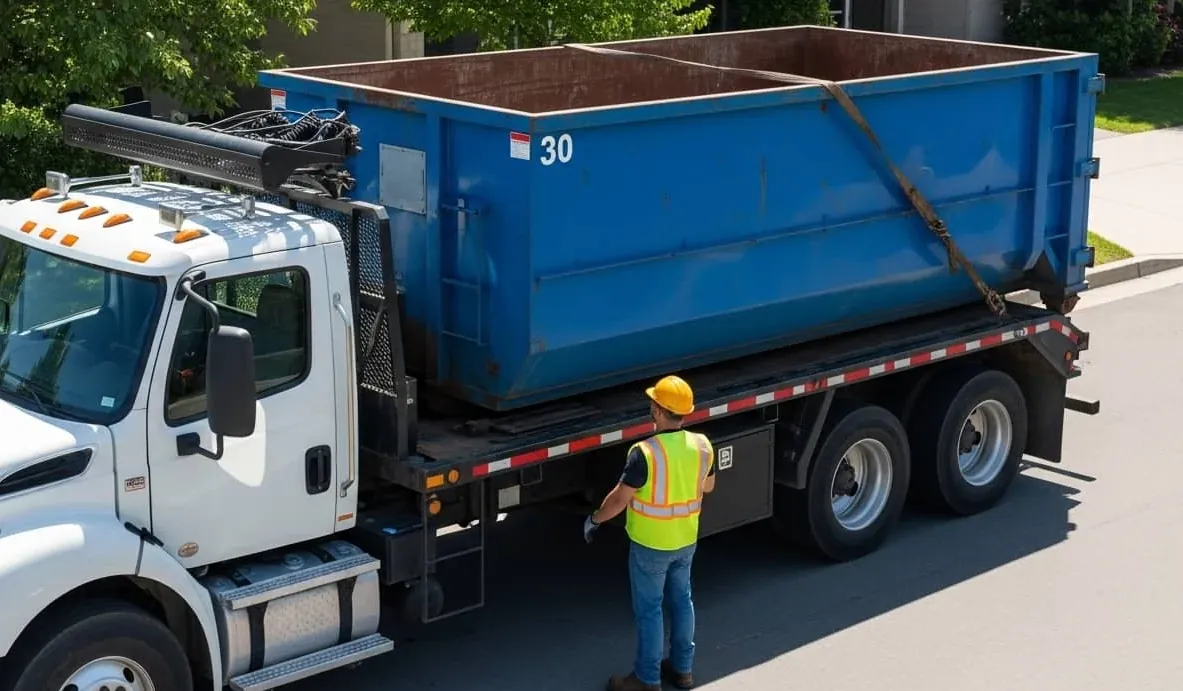
People ask me this on almost every drop-off, usually while holding an old TV: "so where does all this actually end up?" It depends on what's in the load, and the difference is worth real money. A roll-off is not a destination. It's the front end of a sorting decision made either in your driveway or at a scale house, and one of those is cheaper than the other.
I've been hauling in Lakewood and across Jefferson County since 2012. Here's how the system actually works — the facilities, the state rules, the county programmes, and the metro policy layer that means a Denver job and a Wadsworth job aren't governed by the same paperwork.
Three streams, three different buildings
Almost everything we haul falls into one of three streams, and they don't go to the same place.
Municipal solid waste
Household trash, furniture, carpet, mixed cleanout material. This goes straight to a lined municipal solid waste landfill, or through a transfer station first where loads are consolidated into walking-floor trailers for the longer run. A lined MSW landfill is engineered — liners, leachate collection, gas capture, groundwater monitoring wells. That engineering is why it's the most expensive per ton of anywhere we tip, and the wrong home for material with somewhere better to go.
Construction and demolition debris
Framing, drywall, shingles, siding, tile, cabinets, insulation. C&D goes to a dedicated C&D landfill or processing facility and generally tips at a lower rate than MSW because the material is inert and dry. That's why we keep construction debris separate from household trash whenever the job allows — one bag of kitchen garbage can reclassify a clean C&D load.
Recovered material
Everything with a second life goes elsewhere: single-stream recyclables to a materials recovery facility (a MRF, where optical sorters, magnets and eddy-current separators split the streams); metal to a scrap yard; concrete, brick and flagstone to a crusher that makes road base and aggregate; clean wood and branches to a mulch or compost yard. None of that is landfill. Some of it pays.
The scale house is where your bill gets written
A loaded roll-off crosses a certified truck scale on the way in and again empty on the way out. The difference is your net tonnage, and the facility charges by the ton against whatever rate class the load falls into. That ticket is the single biggest variable in what a job costs.
Which is why sorting before material goes in the can isn't a gesture — it's arithmetic. Pull the steel and it stops being tonnage you pay to bury and starts being tonnage a scrap yard pays you for. Keep concrete out of a mixed load and it tips at aggregate rates instead of trash rates. More on that in our guide to dumpster costs in Lakewood. Density matters too: concrete, dirt, tile and shingles need their own container, usually a small one filled partway. That's why heavy-debris cans exist, and why a 20-yard box suits bulky-but-light material rather than rubble.
Colorado's disposal rules, item by item
Colorado prohibits several categories of material from solid waste landfills outright. These are state rules, not company policy, and every hauler in the metro is bound by them.
- Electronics. Colorado's electronics landfill ban covers televisions, computers, laptops, monitors, printers and peripherals — keyboards, mice and the rest of the desk clutter. They must be recycled rather than buried. This one catches people on estate and office cleanouts.
- Waste tires. Tires are restricted from landfill disposal and handled through dedicated tire recyclers and collection programmes.
- Lead-acid batteries. Car, truck, tractor and marine batteries are banned. Most auto parts stores take them back, often with a core credit.
- Used oil. Motor oil is prohibited and goes to a used-oil collection point for re-refining.
- Free liquids. Liquid waste, or waste containing free liquids, cannot go into a landfill unless the facility is specifically permitted for it. Practically: anything that sloshes stays out of the can.
The current list lives with CDPHE and is worth a look before a big cleanout. Plain-language version in our post on what can and can't go in a dumpster in Jefferson County.
Where it goes locally
Jeffco residents have a genuinely good household hazardous waste option in the Rooney Road Recycling Center, a county-supported HHW facility taking paint, cleaners, pesticides, motor oil, antifreeze, batteries and electronics from county households. It runs by appointment on limited days — check the county or the centre's own site for current hours, eligibility and fees before you load the truck.
The City of Lakewood layers its own programmes on top: curbside recycling, periodic drop-off and cleanup days, seasonal yard waste collections, and a voucher toward the county slash programme. Lakewood also runs periodic electronics collection and document-shredding events — the easiest legal way to clear a garage of old towers and monitors. Dates move year to year, so check the city site rather than trusting a number you read anywhere, including here.
For leftover architectural paint, PaintCare runs a statewide network of year-round drop-off sites, mostly at paint and hardware retailers, taking house paint, primers, stains, sealers and clear coatings, plus a large-volume pickup service contractors should know about. Paint is the number one thing I find in cans that shouldn't be there, and it has the easiest alternative of anything on this list.
The metro policy layer: a Lakewood job and a Denver job are not the same job
Two things have changed the ground rules across the Front Range, and if you work both sides of Sheridan you need to know both.
Denver's Waste No More ordinance requires recycling and diversion on construction and demolition work inside the City and County of Denver, with a plan submitted through the permit process on covered projects. It's a Denver requirement — it does not follow you across the line into Lakewood or unincorporated Jeffco. If you bid both, your documentation has to flex. More in our piece on construction debris disposal across the Denver metro.
Colorado's producer responsibility programme for packaging and paper is the bigger long-term shift. Producers fund the residential recycling system through a statewide producer responsibility organisation, with the goal of expanding curbside access and standardising one accepted-materials list statewide. The "can I recycle this?" answer is slowly becoming the same in Lakewood, Golden, Arvada and Denver instead of five different answers. It's still rolling out — verify with your hauler or the city before assuming a new material is accepted.
Where does this actually go?
| Item | Where it goes | Why |
|---|---|---|
| Leftover paint (latex or oil) | PaintCare drop-off site or county HHW | Free liquids are banned from landfill; oil-based never goes in the can |
| Motor oil, antifreeze | County HHW or an auto shop that takes used oil | State-prohibited; a gallon contaminates a lot of groundwater |
| Propane cylinders | Exchange programme or HHW — never the dumpster | Pressurised vessels explode in compactors and landfill fires |
| TVs, computers, monitors, printers | Electronics recycler or a county/city e-waste event | Covered by Colorado's electronics landfill ban |
| Refrigerators, freezers, window AC | Appliance recycler for refrigerant recovery, then scrap | Refrigerant must be recovered before the shell is crushed |
| Evaporative (swamp) coolers | Scrap metal yard | No refrigerant — a fan, a pump and a lot of galvanised sheet and copper. Pure scrap value |
| Mattresses and box springs | Mattress recycler where available, otherwise MSW | Steel, foam and wood recover separately; some landfills surcharge them |
| Tires | Tire recycler or a collection event | Restricted from landfill; they float back up through cover |
| Scrap metal — appliances, pipe, rebar, fencing, auto parts | Scrap yard | It has cash value. Never pay tipping fees to bury metal |
| Branches, slash, clean brush | Slash and mulch programme or compost yard | Chipped into mulch; supports wildfire mitigation |
| Concrete, brick, block, flagstone | Concrete crusher | Crushed into road base — reused, not buried |
| Landscape rock, cobble | Reuse, or aggregate/fill | Worth something to landscapers; dead weight in a trash can |
| Clean flattened cardboard | Curbside recycling or MRF | High-value commodity — if it's dry and flat |
| Mixed household trash | Transfer station, then lined MSW landfill | The most expensive per ton of anything on this list |
Scrap metal deserves a second mention because it's the one people get wrong most expensively. Swamp coolers, water heaters, chain link, cast-iron radiators, appliance shells, copper and aluminium are all commodities. Paying by the ton to bury them is the worst outcome available. On estate cleanouts we pull metal out as routine.
The water angle, which matters more here than most places
The Front Range is semi-arid. We have no water to spare, and everything that hits the ground here drains toward Bear Creek, Clear Creek and eventually the South Platte. Storm drains are not treated — a storm drain is a pipe with a creek on the other end. Paint rinsed into a gutter, oil poured on gravel, antifreeze on a driveway: that reaches water somebody downstream is drinking, irrigating with or fishing in. In a state this dependent on its watersheds, "it's only a gallon" isn't an argument. That's why the free-liquids rule exists, and why we won't take liquids in a can.
Slash, defensible space and the wildfire side of it
Up in the foothills — Evergreen, Conifer, Indian Hills — defensible-space work generates a lot of woody debris, and it should not go to a landfill. Jefferson County's SLASH programme takes tree limbs, prunings and pine cones seasonally, chips them, and turns the result into mulch residents can load for free. Lakewood offers its residents a voucher toward it. The rules are strict — clean woody debris only, no construction lumber, no stumps, pine needles kept separate — so read the county's current guidance before you haul.
For hedge trimming, sod and general landscape teardown, a yard waste can keeps material headed for a compost or mulch yard. Same on xeriscape conversions, where you're pulling sod, old rock and irrigation at once — three destinations in one project.
How much of a C&D load is genuinely recoverable
Nationally, C&D debris runs to roughly 600 million tons a year — more than double the municipal solid waste stream — and most of it is directed to next use rather than landfilled, largely as aggregate. That works because the big-volume components are recoverable by nature: concrete crushes, metal melts, clean wood grinds, cardboard bales.
On a real remodel the recoverable fraction depends on how the job is staged. Demo everything into one pile and you've made mixed waste. Pull metal first, keep masonry in its own container, flatten cardboard, set clean wood aside, and a surprising share never sees a landfill. Same logic as sizing a container per material rather than one giant box — see our sizing guide. Even a roofing tear-off gives up flashing, vents and gutter to scrap.
What we do about it, so you don't have to
Cole Barrett started this company in 2012 and the sorting policy hasn't changed since: recoverable material comes out before the load gets tipped. Metal to the scrap yard. Concrete and masonry to a crusher. Clean wood and green waste to a mulch or compost yard. Cardboard to a MRF. What's genuinely left goes to the right landfill class, weighed and documented. You don't need a sorting station in your driveway — tell us what's in the job when you book, and we'll stage the container to match.
We do this across Lakewood, Golden, Wheat Ridge, Arvada, Morrison and the west Denver metro, from a single-can garage clear-out to a full remodel, and on labour-included junk removal when you'd rather not touch it. Flat-rate, licensed and insured, and a straight answer about where your material went. Call LWC Dumpster Rental Lakewood at (720) 473-6600 and tell us what you're clearing out — we'll tell you which streams it splits into and what size can each one needs.
Questions this guide did not answer? Call (720) 473-6600. We would rather spend two minutes on the phone than have you order the wrong container.