
Cleanouts
The Estate Cleanout Checklist: Clearing a Family Home in Lakewood Without Losing Your Mind
A practical, room-by-room estate cleanout checklist for Lakewood families: what to find before you throw anything away, the hazards hiding in older ranches, what sells, and how to size the container.
I have been hauling containers around Lakewood since 2012, and the estate cleanout is the job I take the most care with. Somebody's mother lived in that brick ranch on Kendall for forty-six years. The garage still smells like her husband's shop. And now four adult children who see each other twice a year have to empty it before the house lists in six weeks.
This is a checklist, not a pep talk. Work it in order.
Before You Throw Anything Away: The Paper Sweep
Do this first. Not after the first load, not once the bedrooms are clear. First. Paper is the cheapest thing in the house to move and the most expensive thing to lose.
Walk the house with a banker's box and pull every document you find. The obvious ones: the will, deeds, life insurance policies, three to five years of tax returns, bank and brokerage statements, vehicle titles. Then the ones people bin by accident because they look like junk mail:
- Trailer, boat, camper and ATV titles — often loose in a garage drawer, not in the file cabinet.
- Savings bonds — paper Series EE and I bonds turn up in Bibles, sock drawers and freezer bags constantly. They are still worth money.
- Safe-deposit box keys — a small flat key with no fob. If you find one and nobody knows the bank, keep it.
- Military discharge papers (DD-214) — needed for burial benefits and headstone claims.
- Mineral rights and royalty statements — genuinely common in Colorado estates. A quarter-page check stub from an operator may represent an asset the family does not know exists.
- Water rights, ditch company shares and well permits — same deal. Older Jefferson County families sometimes hold shares that came with property sold decades ago.
- Handwritten notes about who gets what — not legally binding on their own, but they matter enormously to the family, and they can be relevant to the attorney.
On the legal side: in Colorado, an estate is opened through the district court in the county where the person lived, which for most Lakewood residents means Jefferson County. Court forms and general information are published by the Colorado Judicial Branch. The person appointed personal representative should have their letters in hand and should talk to the estate attorney before disposing of assets — especially vehicles, firearms, jewelry and anything with a title. I am a dumpster guy, not a lawyer. Confirm authority, then clear the house.
The Lakewood House Itself
Most of what we clear on the west side is a 1950s to 1970s brick ranch or split-level: full basement, crawlspace hatch somewhere inconvenient, attached single or double garage, and a shed out back that nobody has fully opened since the Clinton administration. Forty or fifty years of one family in one house produces a very specific inventory, and a few specific hazards.
Look for these before you start hauling:
- Evaporative cooler on the roof. Half our older housing stock still has one. Do not let a well-meaning nephew climb up to pull it. That is a two-person job with proper footing, and the roof under it is often soft.
- Asbestos duct wrap and pipe insulation. Grey or white wrap on old octopus furnace ducts and boiler lines. Leave it alone and get it tested.
- Buried oil tanks. On some of the older lots, a fill pipe or vent pipe sticking out of the foundation is your tell. Flag it for the realtor immediately.
- Ammunition and firearms. Extremely common in Colorado households, and often not where you would expect — closet shelves, under mattresses, in the garage, in a tackle box. Nothing with a firearm goes in a container, ever.
- Propane cylinders, camp fuel and Coleman canisters from decades of camping and hunting.
- Pool and spa chemicals, old pesticides, and gallons of unmixed paint on basement shelving.
The Four-Box Method, Room by Room
Four staging zones, labeled, in every room: Keep, Family (contested or to be divided later), Sell or Donate, Dispose. Not five. Not "decide later" — that is what the Family box is for, and it goes in the garage untouched until everyone is together.
Finish one room completely before opening the next. The single biggest reason cleanouts stall is people wandering the house opening boxes. Close the door on a finished room and move on. The same discipline applies to any big clear-out, and we cover the general version in our home cleanout checklist.
| Room | Check before tossing | Typical volume | Where it goes |
|---|---|---|---|
| Kitchen | Cash and bonds taped under drawers, freezer envelopes, good cast iron, sterling flatware | 2–3 cu yd | Donate usable; container for the rest |
| Bedrooms / closets | Jewelry boxes, ammunition on shelves, coat pockets, photo envelopes | 3–5 cu yd | Textiles to donation; mattresses to container |
| Home office / den | Deeds, titles, DD-214, mineral and royalty statements, safe-deposit key | 1–2 cu yd | Paper sweep first; shred sensitive |
| Basement | Paint, chemicals, canning jars, tools, holiday storage, water-damaged goods | 6–12 cu yd | PaintCare and HHW; container for the rest |
| Garage / shed | Titles, fuel cans, propane, fertilizer, real tools worth selling | 5–10 cu yd | Sell tools; hazardous diverted |
| Crawlspace / attic | Rodent damage, insulation, forgotten boxes, ductwork condition | 2–4 cu yd | Container; test suspect materials |
| Yard / patio | Rotten deck furniture, planters, fencing, old grill | 3–6 cu yd | Container; green waste separated |
The Part Nobody Warns You About
The stuff is easy. The people are the job.
Some honest advice from watching a few hundred of these. Divide sentimental items by taking turns picking, not by debating value — it takes an hour instead of a month. Expect siblings to be on different clocks; the one who lives closest usually carries the weight and quietly resents it, so say that out loud early. And there is nearly always one relative who wants everything to stop. They are not being difficult. They are not ready. Give them a defined job — photographs, or the china — so they are inside the process rather than blocking it.
Photographs, slides and 8mm film: pull all of it, do not sort it in the house. Boxes of slides get thrown out at 9pm on day three by someone who is exhausted. Get them digitised later and share the files. That is the inheritance everybody actually wants.
What Sells and What Truly Does Not
Families lose weeks trying to sell things that have no market. In this metro, in 2026, here is the honest split.
Sells: real tools — Snap-on, Craftsman USA, table saws, compressors. Ski and outdoor gear, especially newer skis, boots and packs. Bicycles. Solid mid-century furniture with clean lines, teak or walnut. Firearms through a licensed dealer, handled properly. Scrap metal, cast iron, copper and aluminum, which are worth separating into a pile rather than burying in the container.
Does not sell, at any price: china cabinets and formal dining sets. Upright pianos — you will pay to move one. Treadmills. Console and rear-projection TVs. Encyclopedia sets, collector plates and entertainment centers. Let these go on day one instead of day nine.
For donations, the metro has good pickup options through the large thrift and housing charities, and several will take furniture from a driveway with a scheduled truck. Get a written receipt every time — donation value belongs in the estate's records, and the attorney or accountant will ask. Anything a charity declines the same day should go straight to the container; do not let a "maybe" pile grow in the garage.
What Cannot Go In The Container
This is where cleanouts get people in trouble, so it is worth being blunt. Our full list is in what can go in a dumpster in Jefferson County, but the estate-specific ones:
- Paint — take it to a PaintCare drop-off site.
- Chemicals, pesticides, pool chemicals and motor oil — household hazardous waste, by appointment. Guidance is published by CDPHE.
- Propane cylinders — exchange or hazardous waste, never the container. A cylinder in a compactor is somebody's very bad day.
- Televisions, monitors and computers — banned from Colorado landfills. They must go to an electronics recycler. See our recycling and disposal guide.
- Medications — a take-back drop box, typically at a police station or pharmacy. Locations are listed through the DEA.
- Firearms and ammunition — call the police non-emergency line for guidance, or use a licensed dealer.
If The Cleanout Becomes A Renovation
It usually does. Once the house is empty, somebody looks up and says the popcorn ceiling has to go, or wants that kitchen vinyl gone before listing. Stop there. In Colorado, popcorn ceilings and old sheet flooring in pre-1990s homes require testing before you disturb them, and Lakewood is full of pre-1990s homes. Read our asbestos testing guide before anyone picks up a scraper. A sample costs very little. Doing it wrong costs a great deal, and the liability lands on the estate.
The Container Plan
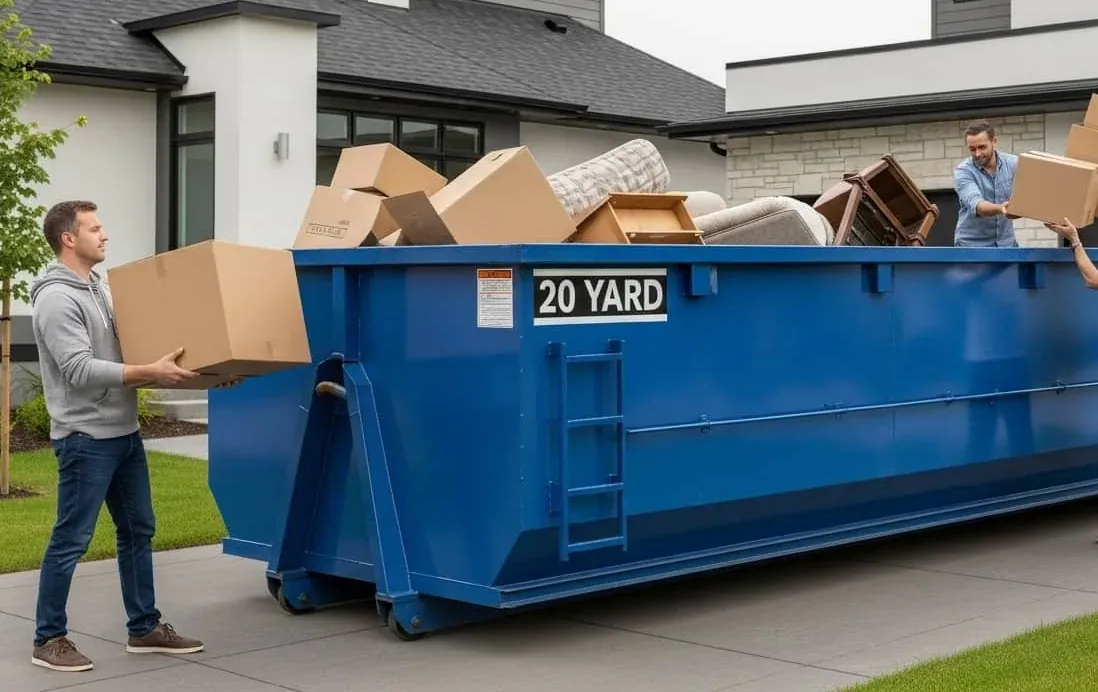
Sizing, plainly. A two-bedroom condo or a well-kept small ranch: a 20 yard. A typical three-bedroom Lakewood ranch with a full basement and a garage: a 30 yard, and that is what we drop most often. A long-tenured home with a packed basement, a shed and forty years of accumulation: a 40 yard, or a 30 with a swap mid-week. If you are between sizes, our sizing guide works through it, and I would rather talk it through on the phone than have you guess.
Practical placement: driveway if it will hold, because carrying distance from a basement is the real cost of the job. Every extra twenty feet on a stair-and-hallway carry adds hours. We put boards down as standard — see driveway protection. If the container has to sit on the street, check the permit rules in our Lakewood permit article first.
Stage by floor. Bring everything to one landing zone per level, then load. Heavy and flat items to the back and bottom of the container, bulky and awkward on top.
Timeline And People
Realistic numbers: a three-bedroom Lakewood house with a full basement is a three-to-five day job with four able-bodied adults. It is not a weekend for one person, and treating it that way is how families end up angry and injured. Budget one full day just for the garage and shed.
Talk to the realtor before you start. Agents often want certain items left — appliances, window coverings, a workbench — and they will tell you what actually improves the listing photos versus what is wasted effort. Coordinate the container dates with the listing date so nothing sits on the driveway during showings.
We keep our end simple: flat-rate pricing so there are no surprises for the estate, discreet delivery, swaps when you need them, and no pressure on your timeline. If it takes eleven days instead of four because a sister flew in late, that is fine. Details on how we run these are on our estate cleanout page.
One Last Thing
You will find something on day two that stops you cold. A birthday card, a photograph, a note in handwriting you know. Sit down on the basement stairs for ten minutes. It is not lost time. Every family we have worked with has that moment, and the ones who allow for it get through the week better than the ones who try to power past it.
When you are ready to talk about a container, call Cole at (720) 473-6600 or reach us through our contact page. Tell us it is an estate and we will handle the scheduling quietly, work around the family, and give you a flat price you can put in the estate's records. No pressure, no clock running in the background.
Questions this guide did not answer? Call (720) 473-6600. We would rather spend two minutes on the phone than have you order the wrong container.