
Delivery & Placement
Will a Dumpster Wreck My Driveway? How Delivery Really Works in Lakewood — and How We Protect Your Property
A Lakewood hauler explains exactly how a roll-off gets delivered, the two pressure points that damage driveways, what each surface can take, and the Front Range soil, slope and winter factors generic guides skip.
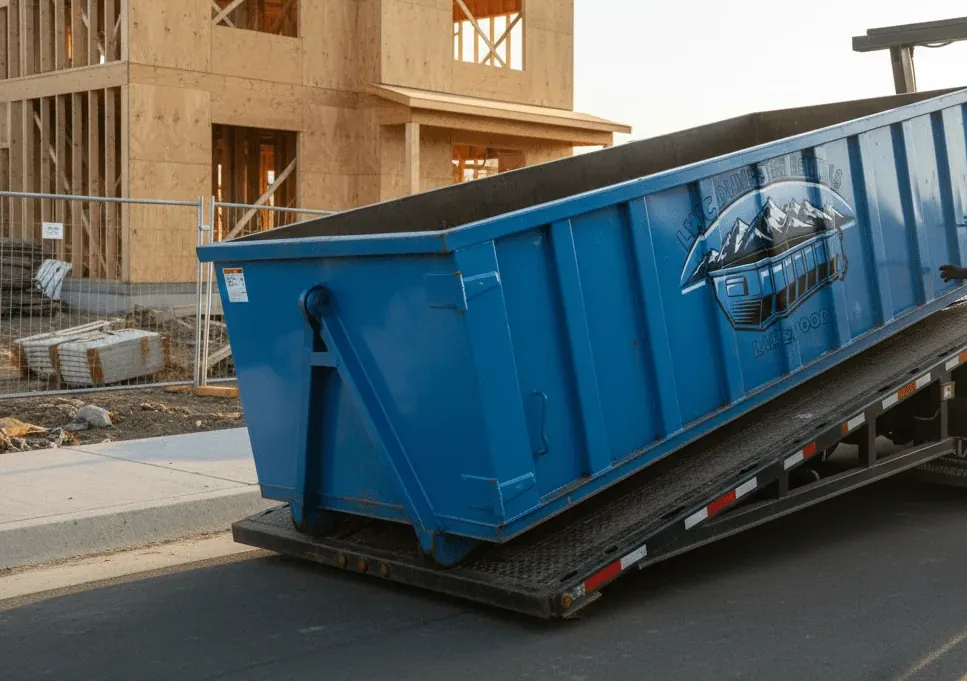
Every week somebody asks me a version of the same question before they'll book: "Is that thing going to crack my driveway?" Fair question, and I'd rather you ask it than lie awake about it. I've been setting roll-offs across Lakewood and Jefferson County since 2012, and the honest answer is this: the vast majority of driveways come out of a rental looking exactly like they did the morning we pulled up. The handful that don't were slabs already failing before my truck turned the corner.
What actually happens when the truck backs in
A roll-off delivery is not a crane drop. The driver backs into position, sets the brake, and raises the hoist so the bed tilts toward the ground. The rear rollers touch down first, the winch cable pays out, and the can rolls backward down the tilted bed on four steel wheels. Once it's fully off the truck, the driver pulls forward and the container settles flat onto its two long steel rails.
That gives you exactly two pressure points to think about:
- The wheels, during the roll. For maybe eight to fifteen seconds, the entire empty weight of the container is riding on four contact patches roughly the size of your palm, and they're moving. That's the moment that gouges asphalt and chips a paver edge.
- The rails, while it sits loaded. This is the long-duration load. Two steel runners bearing down on your slab for three days, five days, sometimes two weeks, while the weight inside climbs the whole time.
Everything we do to protect a driveway is aimed at one or both of those two moments. Every one of our drivers gets out and walks the drop before backing in — not a windshield glance, an actual walk with boots on the ground.
The physics, in real numbers
An empty 20 yard container weighs roughly 4,000 to 5,000 pounds — call it a couple of tons before you've thrown a single shingle in it. Load it with household debris and you're at 4 to 6 tons. Load it with roofing tear-off, plaster, or wet carpet and 8 to 10 tons is routine. A loaded 30 yard or 40 yard box goes higher again, though those sizes are usually holding light bulky material rather than dense debris.
Spread 10 tons across two steel rails instead of four air-filled tires and you see why we care. It isn't total weight that hurts concrete — it's pounds per square inch on a small footprint, held for days. That's why we ask what's going in the box when you call. A concrete and heavy debris load behaves nothing like a garage cleanout, and we'll size and place it differently. See our full size lineup if you're still deciding.
The Front Range problem nobody warns you about: your dirt
Denver metro sits on expansive bentonite clay. That soil swells when it gets water and shrinks when it dries, and it does not do it evenly. It's why so many houses west of Sheridan have floating basement walls, and why a huge share of the driveways I see in Lakewood, Applewood, Green Mountain and Bear Creek already have a heaved panel, a settled corner, or a diagonal crack through the middle. That damage was done by soil, not by a truck.
Then add altitude. We cross the freezing line dozens of times each winter, sometimes twice in a day. Water gets into a hairline crack, freezes, expands about nine percent, and pries it wider. Fifteen years of that gives you the classic west metro driveway: structurally sound-ish, cosmetically tired, with joints ready to move.
So do this: photograph your driveway before we arrive. Ten timestamped phone pictures of the existing cracks and settled panels, texted to us. It costs four minutes and settles any question later, in your favor or ours.
What each surface can actually take
| Surface | Risk level | What we do | What you should do |
|---|---|---|---|
| Poured concrete, 4"+ and healthy | Low | Boards under wheels and rails as standard; place mid-slab, away from edges | Photograph existing cracks and control joints; tell us if any panel rocks |
| Thin, old, or already-cracked concrete | Moderate | Double up boards, spread the rail load, keep off failing panels | Point out the bad panels; consider a street or curbside set instead |
| Stamped or decorative concrete | Moderate to high | Full plywood coverage under the roll path; sealer scuffing is still possible | Strongly consider an alternate spot — we can't guarantee a stamped finish |
| Asphalt | High in summer heat | Book a morning drop; wide plywood under wheels and rails | Avoid 90-degree afternoons entirely; no long sits in July or August |
| Pavers or brick | High | Continuous board path so no single paver takes an edge load | Expect possible settling; have a few spare pavers on hand |
| Gravel or crushed rock | Low damage, moderate rutting | Boards under the rails to stop sinking | Plan to rake and re-level after pickup |
| Lawn or bare soil | Low value, high mess | Boards; we decline if the ground is saturated | Accept ruts and dead grass; don't ask for it after a wet week |
A word on asphalt, because our sun matters. At 5,400 feet the UV load is brutal and a dark drive can sit 40 to 50 degrees hotter than the air by 2 p.m. in July. Warm asphalt behaves like firm clay — wheels emboss it, rails press trenches that never fully recover. Morning drops on asphalt, every time. That's a rule at our shop, not a preference.
Foothills driveways, alleys, and tight older lots
If you're up toward Morrison, the Ken Caryl valley, or out past C-470 toward Evergreen, your issue isn't the surface — it's the grade. A loaded container on a slope is thousands of pounds looking for a reason to move, and steel wheels on wet or icy concrete do not hold. We will not set a can where gravity can take it, period. On steep lots we look for a flat pad, a turnaround, or a shoulder, and if there isn't one we say so before you pay a dime. Our service area page lays out where we run.
The opposite problem lives in older Lakewood, Edgewater and west Denver: alley access, 1950s single-car driveways, approaches narrower than the truck. Sometimes the alley is the answer and sometimes it's a trap — overhead lines, a dogleg, a neighbor's parked car. Send a photo of the approach and we'll tell you honestly. If the only workable spot is the street, you may need a right-of-way permit; we cover that in our Lakewood permit guide, and the City of Lakewood handles the paperwork.
Xeriscape: the most expensive thing on the property
Half of west metro has pulled the bluegrass for decorative rock, flagstone, drip line and boulder edging. Good for water bills, bad for heavy trucks. Drip tubing an inch under the mulch shears under a tire and you won't know until plants brown out three weeks later. Flagstone paths crack. Boulder edging shifts and drags the rock border with it.
Mark it. Marking flags, upside-down buckets, a couple of orange cones — anything my driver can see from the mirror. Same goes for sprinkler heads and the valve manifold box. If you're doing the landscape conversion itself, our xeriscape debris guide and yard waste service cover how to stage sod, rock and old edging.
Winter deliveries
Snow hides everything — the crack you wanted us to avoid, the sprinkler head, the curb edge. Snowbanks also eat placement space; a berm from the plow can shrink a usable pad by four feet. And sheet ice under steel rails means a loaded container can slide even on ground you'd call flat. If conditions are bad, we'd rather come back a day later than set a can somewhere it can move. Clear and sand the drop area before we arrive and we'll almost always make it work. If a storm is closing passes, check CDOT before you plan around us.
How we actually protect the surface
Protection boards are standard on every residential delivery we do — not an upsell, and you don't have to ask. That means plywood or dimensional lumber along the roll path so the wheels never touch bare surface, and boards under the rails at the resting spot so the long-term load spreads across a much larger footprint instead of two steel lines. On pavers and decorative concrete we run continuous coverage, not spot pads. Same weight, a lot more square inches.
Measuring your space
Rough footprints, with a couple feet of working room on each side:
- 10 yard — about 12 ft long, 8 ft wide, 3.5 ft tall
- 15 yard — about 14 ft long, 8 ft wide, 4 ft tall
- 20 yard — about 22 ft long, 8 ft wide, 4.5 ft tall
- 30 yard — about 22 ft long, 8 ft wide, 6 ft tall
- 40 yard — about 22 ft long, 8 ft wide, 8 ft tall
Beyond the box itself, we need roughly 60 feet of straight approach to line up and back in, and about 23 feet of overhead clearance for the hoist at full tilt. That overhead number is the one people miss. Watch for service drops from the pole to the house, mature street trees on the older Lakewood blocks, basketball hoops over the apron, and low garage-door trim. If you're not sure what fits, our sizing guide walks it through.
What's under the surface
Sprinkler heads and manifolds, sewer laterals, septic tanks and leach fields on unincorporated foothills lots, radon mitigation pipe along the foundation, gas service lines, invisible-fence wire. A loaded container over a leach field is a genuinely expensive mistake. We don't dig, but if your project involves any excavation, call Colorado 811 at least two business days ahead — it's free and it's state law.
One more hard rule: new concrete. A slab poured within about a month should not take a loaded container at all. Concrete keeps gaining strength for weeks, and a fresh pour that looks and feels hard will still craze or crack under rail load. If your driveway is new, tell us and we'll find another spot.
Your five-minute pre-delivery checklist
- Move every vehicle, trailer and trash cart out of the approach and the drop zone
- Photograph existing cracks, stains and settled panels
- Flag sprinkler heads, drip lines, flagstone and boulder edging
- Look up — wires, branches, hoops
- Mark your preferred spot with a cone or a chalk X, and tell us which way you want the doors facing
- In winter, shovel and sand the pad
- Keep kids and dogs inside for the ten minutes we're setting it
Who's liable, honestly
Here's how a straight hauler operates, and you should expect the same from anyone you hire. We're licensed and insured, and if my driver does something careless — clips a garage post, drives across marked landscaping, ignores your instructions — that's on us and we make it right. What no reputable hauler covers is ordinary consequential wear on a surface you directed us to use: a hairline extension at a control joint on a twenty-year-old slab, minor rutting in gravel, an asphalt impression in August. Most contracts, ours included, put placement risk on the property owner once you've chosen the spot. That's why the walk-around, the boards, and your before-photos matter so much — they turn a vague argument into a documented one.
We do residential rentals, roofing tear-offs, construction jobs and estate cleanouts at flat rates, and placement gets the same attention on all of them.
Not sure your driveway or your approach will work? Call us and describe it, or text a couple of photos and we'll tell you straight — including if the answer is "put it on the street." A five-minute site check beats a five-thousand-dollar surprise. Reach Cole and the crew at (720) 473-6600, or send details through our contact page.
Questions this guide did not answer? Call (720) 473-6600. We would rather spend two minutes on the phone than have you order the wrong container.